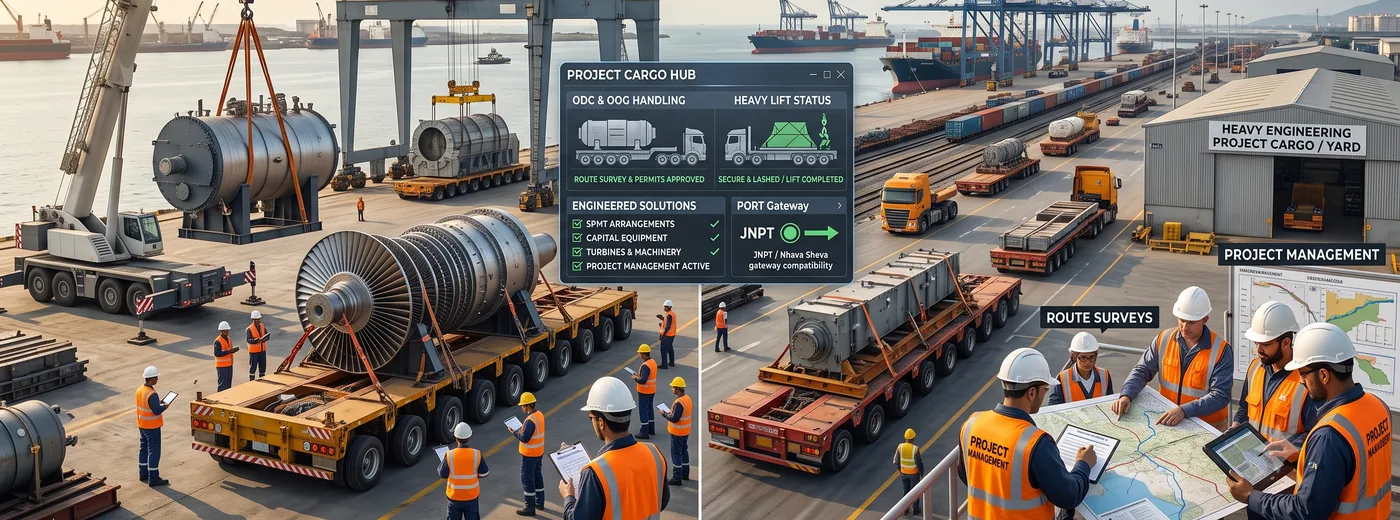
Over-dimensional consignments need route surveys, permits, and equipment planning long before the vessel arrives.
Cargo becomes over-dimensional when it exceeds the legal envelope for road movement, or out-of-gauge when it will not sit within standard container dimensions. Either way, it leaves the standard logistics process and enters a planned, permitted one.
Before committing to a delivery date, the physical route must be surveyed: bridge load ratings, overhead clearances, turning radii, and road widths. A route survey conducted after the cargo has landed is a route survey conducted too late.
ODC movement requires permissions from the relevant state authorities along the entire route, and each state applies its own thresholds. Where the route crosses several states, approvals must be sequenced so none expires before the cargo reaches that leg.
Hydraulic axle trailers, low-beds, and multi-axle configurations each suit different weight and geometry profiles. Selecting equipment is a function of the survey findings, not a decision that can be made from the packing list alone.
At the port, heavy lift requires crane capacity, a lift plan, and coordination with terminal operations. Slots for such handling are finite, which is why they are booked against the vessel schedule rather than against the cargo's readiness.
Project cargo rarely fails on any single element. It fails when survey, permit, equipment, and berth availability are planned independently and then do not converge. Handling all four from one desk is what keeps the sequence intact — the core of our project cargo and ODC/OOG service.
Our team operates from Nhava Sheva. Send us the details and we will come back within two business hours.
Get a Free Quote →